
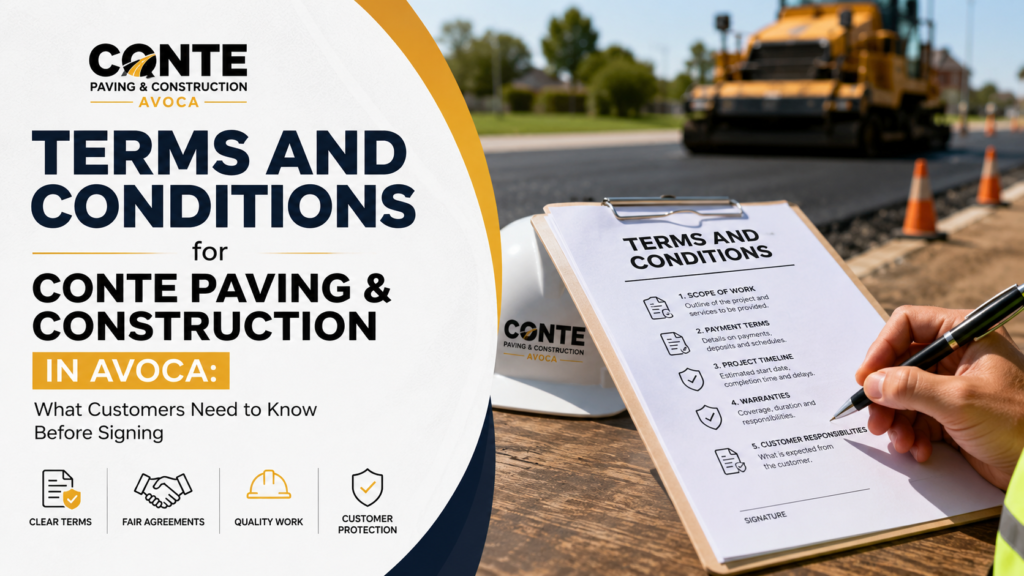
Engaging Conte Paving & Construction for a paving, concrete, or excavation project in Avoca, Pennsylvania is a contractual relationship one that is governed by the terms and conditions the company presents as part of its proposals, service agreements, and invoices. For homeowners and commercial property managers in Lackawanna and Luzerne Counties who may sign multiple contractor agreements each year, understanding what a paving contractor Terms and Conditions Conte Paving & Construction Avoca cover, what provisions are particularly important in Northeastern Pennsylvania context, and what questions to ask before signing protects both parties and sets the project up for success.
Why Terms and Conditions Matter
Terms and conditions are not formalities that can safely be ignored. They govern every significant aspect of the business relationship: what work is included in the agreed scope, what happens when site conditions require scope changes, what the payment obligations are and what happens when they are not met, what the contractor warranties cover and what they exclude, and how any disputes between the parties will be resolved. Property owners who read and understand these provisions before signing are better equipped to manage their projects and protect their interests if disagreements arise.
Scope of Work and Change Order Provisions
The scope of work defined in a Conte Paving project agreement specifies what is included the type and depth of base preparation, the asphalt thickness, any drainage or grading work, and any concrete or excavation components. Change orders arise when conditions discovered during the project differ from what was assumed when the proposal was prepared finding soft clay sub-grade that requires additional stone base, for example, or discovering buried debris that must be removed before paving can proceed. Quality contractor terms include:
- Clear change order procedures: Any additional work must be documented in writing before it is performed, with an agreed adjustment to price and, if applicable, schedule.
- Unit pricing for common conditions: Some terms include pre-agreed unit rates for common scope expansions, such as additional base stone per ton, making the pricing of discovered conditions transparent and agreed in advance.
Property owners should be cautious of contractors who request verbal authorization for additional work without written documentation undocumented scope changes are a frequent source of project disputes.
Weather and Seasonal Provisions in Northeastern Pennsylvania
Asphalt paving is highly weather-sensitive, and terms for contractors working in Northeastern Pennsylvania climate typically address this reality specifically. Key provisions to look for:
- Temperature restrictions: Hot mix asphalt cannot be successfully installed below approximately 40 to 50 degrees Fahrenheit. Terms should specify that the contractor may reschedule without penalty when temperatures are outside the acceptable range.
- Rain restrictions: Asphalt must be applied to dry surfaces. Rain during or immediately before paving prevents proper installation. Terms should address rescheduling flexibility for precipitation.
- Spring weight restriction periods: Pennsylvania county roads are subject to spring weight restrictions during the thaw period, which can delay heavy material deliveries and equipment access. Terms addressing force majeure conditions typically cover these restrictions.
Payment Terms and Pennsylvania Mechanics Lien Law
Paving contractor payment terms in Pennsylvania carry a specific legal context that property owners in Avoca must understand. Pennsylvania Mechanics Lien Law gives contractors the right to file a lien against a property for unpaid work a lien that clouds the property title and must be resolved before the property can be sold or refinanced. Specific points to understand from contractor terms:
- Payment schedule: Most paving projects specify a deposit at signing and a final payment upon completion. Larger projects may include milestone payments. Understanding the schedule before work begins allows proper financial planning.
- Lien rights and notice requirements: Pennsylvania law imposes specific preliminary notice requirements on contractors performing residential work to preserve their lien rights. Terms should address whether and how the contractor provides the required preliminary notice.
- Late payment consequences: Terms typically address interest on overdue balances and the contractor right to suspend work for non-payment. Understanding these provisions prevents surprises if invoice processing is delayed.
Warranty Coverage and Its Limits
Asphalt paving warranties in Northeastern Pennsylvania require careful reading because the demanding climate creates real warranty claims. Key points:
- Duration and what is covered: Standard workmanship warranties for asphalt driveways in Pennsylvania typically cover defects attributable to installation errors for one year. Structural failure from freeze-thaw cycling in the first year, if attributable to inadequate installation, would normally be covered. Cracking caused by UV oxidation after several years is not a workmanship defect.
- Maintenance conditions: Many warranties require the property owner to perform basic maintenance avoiding petroleum spills on the surface, not allowing heavy equipment loading on new asphalt during the first curing season as conditions for warranty applicability.
- Exclusions: Natural ground settlement beyond the contractor control, unusual loading, and third-party damage are typically excluded from workmanship warranties.
Conclusion
The terms and conditions for Conte Paving & Construction in Avoca establish the framework within which paving, concrete, and excavation projects in Lackawanna and Luzerne Counties are planned and executed. Understanding the scope definition and change order process, the weather-related provisions relevant to Northeastern Pennsylvania climate, Pennsylvania mechanics lien law implications, and the warranty coverage and exclusions applicable to the completed work positions Avoca-area property owners to enter into contractor relationships with clear, shared expectations the foundation of every successful construction project.